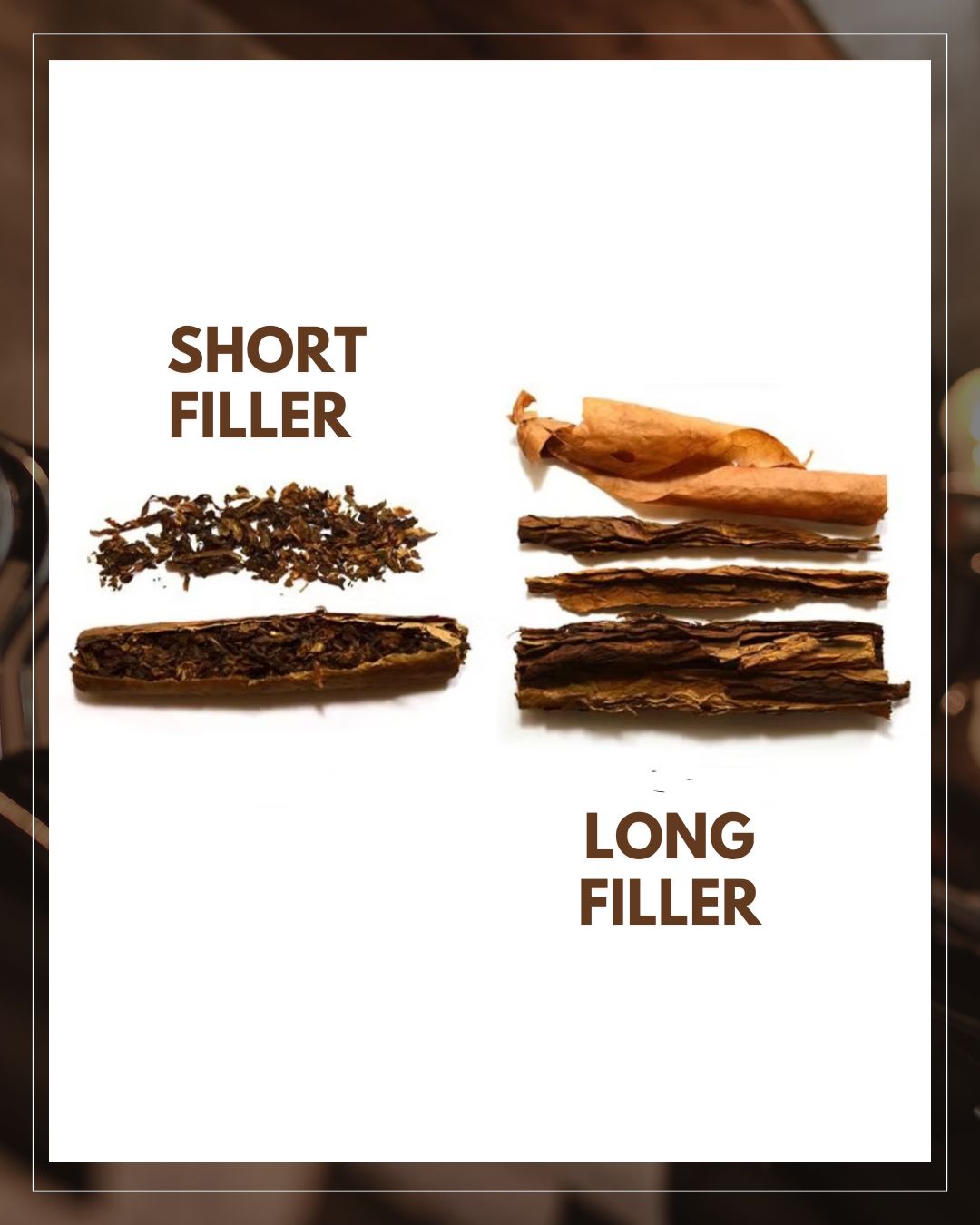
Walk into a serious cigar lounge and the first sorting question — before brand, before origin, before vitola — is whether the cigar is long-filler or short-filler. The Spanish trade vocabulary is older than the English one: tripa larga and picadura. Whole leaves running stem to head versus chopped tobacco swept off the rolling table. The distinction sounds trivial. It isn’t. It separates two entirely different industries that happen to share a plant.
A long-filler robusto from Padrón and a short-filler corona from a Pennsylvania machine-rolled brand both contain Nicotiana tabacum. They share almost nothing else — not the construction, not the burn rate, not the flavor evolution, and not the price. Understanding the difference is the cleanest way to understand why some cigars cost $30 and some cost $3, and why the gap between them is real.
Long-filler: whole leaf, end to end
Long-filler cigars are built from intact tobacco leaves — usually four to six of them per cigar, depending on ring gauge — laid out at full length and bunched by hand. The leaves run continuously from the foot of the cigar to the head. In a 6-inch toro, those filler leaves are 6 inches long. There are no breaks, no chopped sections, no compromises in continuity.
That continuity matters for two reasons. First, the air channels between whole leaves are predictable. A skilled bonchero — the roller who handles the bunch before the torcedor applies the wrapper — folds each leaf with a slight accordion crimp that creates micro-channels for airflow. Done right, the result is the slow, even draw that defines a well-made premium cigar. Done poorly, the same construction produces a plugged cigar, which is why long-filler quality control is the hardest part of factory work.
Second, the flavor architecture depends on the leaf staying intact. In a Cuban Vuelta Abajo blend, a roller might combine three priming positions on a single plant — Volado at the bottom, Seco in the middle, Ligero from the top — and rely on each leaf to deliver its specific character through the burn. Chop those leaves up and you’ve destroyed the blend. The volatile compounds that distinguish Volado from Ligero are spread across the length of the leaf, not concentrated in any one spot.
The three Cuban primings
Cuban tradition (and most New World production that copies it) sorts filler leaves by their position on the plant:
- Volado. Lower leaves. Mildest flavor, best combustion properties. Provides the burn engine for the cigar.
- Seco. Middle leaves. Balanced strength, aromatic. The flavor backbone.
- Ligero. Upper leaves. Strongest, most concentrated, slowest-burning. Used sparingly in the center of the bunch where it can develop heat slowly.
Premium Cuban blends sometimes include a fourth priming, Medio Tiempo — leaves from the very crown of the plant, two leaves per stalk in a good year. These are rare, expensive, and used only in flagship blends like the Cohiba Behike. You cannot blend Medio Tiempo into a short-filler cigar. The leaves have to be intact for the chemistry to mean anything.
Short-filler: chopped, fast, industrial
Short-filler — picadura in trade Spanish — is exactly what it sounds like. Chopped tobacco, often the offcuts and stem-strippings from premium production, fed into machine-rolled cigars at high speed. A factory in Tampa or central Pennsylvania can produce 50,000 short-filler cigars per shift. A premium long-filler operation in Estelí, rolling by hand, produces a few hundred per torcedor per day.
The chopped leaf burns differently. With no continuous fiber, combustion races through the random air pockets between the chopped pieces. The cigar burns hotter, faster, and less evenly. Flavors arrive immediately and stay flat through the smoke — there’s no layering, because there’s no architecture to layer.
That isn’t necessarily bad. A well-made short-filler cigar at the $3-5 price point can be a genuinely enjoyable smoke for what it is — a 20-minute companion to a coffee, or the cigar you give a friend who’s never had one before and shouldn’t be handed a $25 Padrón Anniversary as their first experience. The mistake is comparing it to long-filler, because the two products aren’t trying to do the same thing.
Cigar Aficionado’s glossary keeps the formal definitions consistent, but the more useful distinction is economic. Long-filler is artisanal production. Short-filler is industrial manufacture. They occupy different shelves of the market for the same reason a single-vineyard Burgundy and a $12 supermarket Pinot Noir occupy different shelves — same grape, completely different process.
The middle ground: Cuban sandwich and mixed filler
Between the two extremes sits a hybrid: the mixed-filler cigar, often called a Cuban sandwich or medio tiempo (confusingly — the term overlaps with the Cuban priming). These cigars use chopped short-filler in the core surrounded by whole long-filler leaves on the outside, all wrapped in a long-leaf binder. The wrapper is full-length.
The construction is faster than full long-filler, cheaper to produce, and still hand-rolled. The cigars typically retail in the $5-9 range. Drew Estate’s Kentucky Fire Cured line and several of the more popular Nicaraguan bundles fall into this category. The result is a cigar that draws more like a long-filler than a true machine-made stick, with some of the flavor variation that whole leaves provide, but without the depth that fully whole-leaf construction delivers.
The honest read: mixed-filler is a real category with a legitimate place in a humidor, particularly as a daily smoke or a yard cigar. It’s not a compromise so much as a different product positioned at a different price point. The marketing sometimes obscures this — bundles labeled as “premium” that are actually mixed-filler are common — but a careful buyer can tell from the cut foot. Look at the freshly cut end of an unsmoked cigar. If you can see the cross-section of distinct, continuous leaves, it’s long-filler. If you see a confetti of small chopped pieces, it’s short-filler or mixed.
What this means in flavor and burn
The differences play out in the smoking experience in ways that are easy to verify side by side.
Long-filler: Burn rate of roughly 1 inch per 12-15 minutes for a typical 50-ring-gauge cigar. Cool draw — the smoke shouldn’t feel hot on the palate even into the final third. Flavor layers shift through the smoke as you transition between Volado-dominant lower thirds and Ligero-heavier middles. A well-aged long-filler develops a creamy, integrated character over years in the humidor — the aging process is one of the main arguments for buying premium long-filler in the first place.
Short-filler: Burn rate closer to 1 inch per 6-8 minutes. The cigar runs hot, particularly past the midpoint. Flavor is essentially established in the first few puffs and stays there. The smoke doesn’t reward slow contemplation — relighting is common because the cigar wants to burn quickly and stop.
Mixed-filler: Splits the difference, predictably. Cooler than short-filler, faster than long-filler, with some flavor evolution but compressed compared to a true premium handmade.
Why long-filler costs more
Three reasons, in descending order of importance.
First, leaf grade. Long-filler requires intact, undamaged leaves at full length. The selection process at the escogida — the sorting house where leaves are graded after fermentation — rejects a significant percentage of any harvest for use as long-filler. Tears, holes, insect damage, brittle texture, off-color spots, all knock a leaf down to short-filler grade. In a good Cuban harvest, perhaps 30-40% of leaf grades out at long-filler quality. The rest goes to picadura.
Second, labor. A long-filler cigar takes a skilled bonchero and torcedor roughly 8-12 minutes of combined work. A machine-rolled short-filler takes seconds. Labor in Estelí or Pinar del Río is cheap by Western standards but not free, and the cumulative hours add up.
Third, aging. Long-filler tobacco is fermented in pilones — large bales of bundled leaves — for anywhere from 18 months to several years before rolling. The resulting cigars are often aged a further 6-18 months before shipment. Short-filler skips most of this. The leaf is processed faster, used faster, sold faster. Time has a cost, and premium cigars carry it.
The retail spread reflects this. A long-filler Cuban toro retails for $25-40 at European tobacconists, with Edición Limitada and Gran Reserva releases reaching $80-200. A short-filler machine-rolled cigar of identical dimensions runs $2-5.
The verdict — and a position worth taking
The short-filler debate is largely settled at premium price points. If you’re buying anything above $10 retail and the cigar is short-filler, you’re being overcharged or misled. Above that line, the entire premium market is long-filler. Below it, mixed-filler can be legitimately good value, and pure short-filler has a real place as a casual daily smoke — particularly for new smokers who haven’t yet developed a palate for the kind of slow, layered flavor evolution that justifies a $30 stick.
What’s worth resisting is the snobbery in either direction. A serious smoker has a humidor with both — the long-filler cigars saved for evenings, dinners, the cigar lounge on a Saturday afternoon, and a stash of cheaper sticks for the lawn mower and the morning coffee. The two products don’t compete. They occupy different positions on the same shelf.
What matters is knowing which one you’re holding, what it was built to do, and whether you’re paying the right price for it. Once you can read the foot of a cigar and call it correctly, the rest of the vocabulary — vitola, wrapper color, priming, blend — starts to fit together.