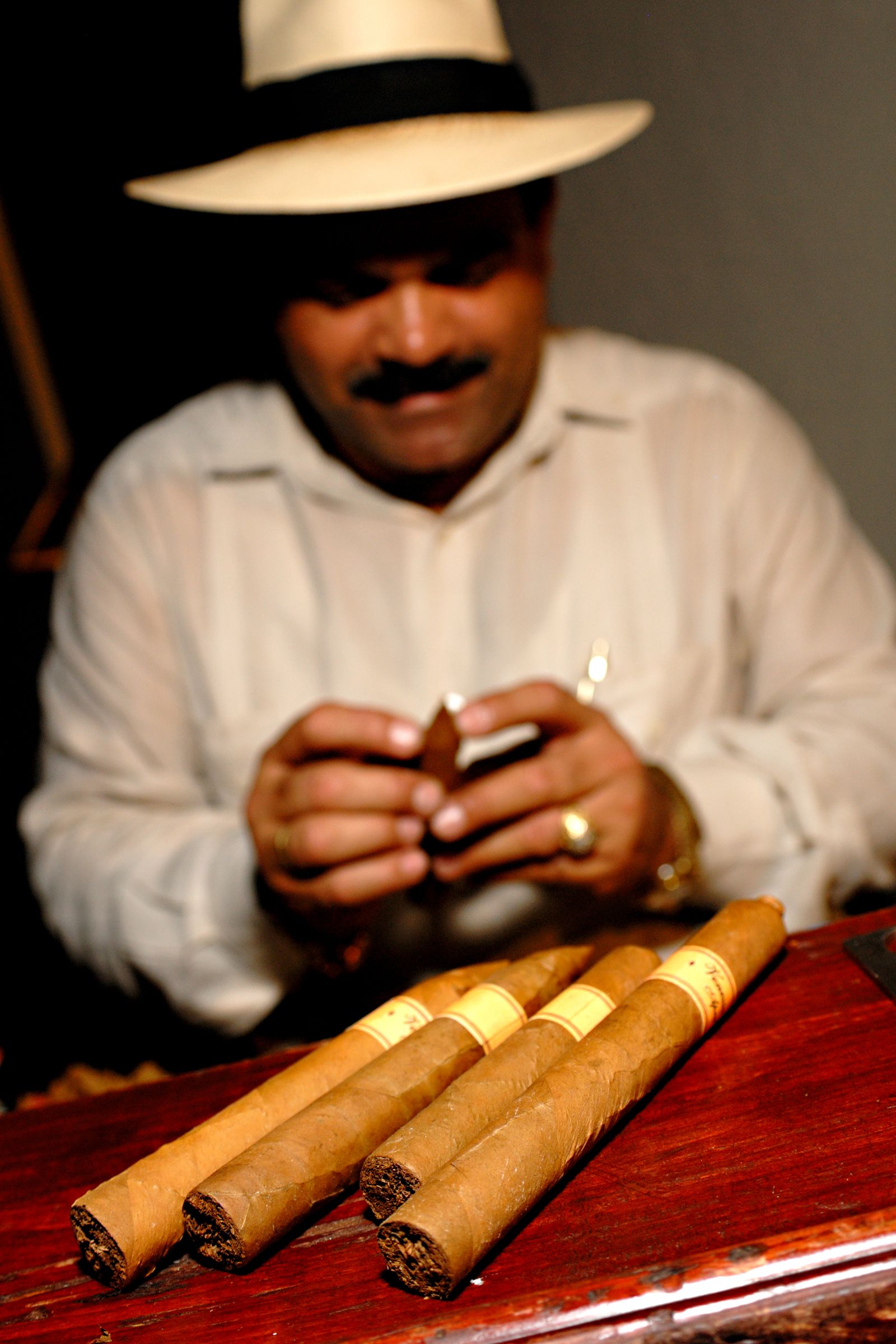
Quick answer: A Habano is a premium cigar that is grown, fermented, blended, rolled, and packaged entirely in Cuba — using only Cuban-grown tobacco — and licensed for export by Habanos S.A., the Cuban state tobacco company. Every cigar that meets all four conditions is a Habano. Every cigar that doesn’t — no matter how good, no matter how “Cuban-seed” the wrapper, no matter how Cuban the brand name — is something else.
That definition matters more than it sounds. The word “Habano” is the closest thing the cigar world has to a Champagne-style appellation. Cohiba, Montecristo, Partagás, Hoyo de Monterrey, H. Upmann, Romeo y Julieta, Trinidad, Bolívar — these are all Habanos brands. The same brand names also exist in Honduras, the Dominican Republic, and Nicaragua, where they were spun off after the 1960 Cuban revolution and are sold legally in the United States. Those aren’t Habanos. They’re separate cigars made by separate companies, using non-Cuban tobacco, with no relationship to the Havana product beyond a shared 19th-century origin story.
The legal definition of Habano
Habanos S.A. is the joint-venture company that holds the global export rights to Cuban premium cigars. Half is owned by the Cuban state tobacco monopoly, Cubatabaco; the other half changed hands in 2024 when Allied Cigar Corporation bought it from Imperial Brands. Habanos S.A. controls every export-grade Cuban cigar that leaves the island.
For a cigar to wear the Habano name on its export band, four things have to be true:
- 100% Cuban tobacco. Wrapper, binder, filler — every leaf grown in one of the five Cuban tobacco-growing regions: Vuelta Abajo, Semi Vuelta, Partido, Remedios, and Oriente. Vuelta Abajo (in Pinar del Río province) produces the premium wrapper leaf used on the most expensive Habanos.
- Hand-rolled in a Cuban factory. No machine-rolled product carries the Habano export band. The big factories — Partagás (now El Laguito), Romeo y Julieta, H. Upmann, La Corona — employ thousands of torcedores (rollers), each one trained for years before being trusted with premium SKUs.
- Aged and blended on the island. Fermentation cycles for premium Cuban tobacco run 18 months to several years. The blend is finalised in Cuba before the cigar is rolled.
- Licensed for export by Habanos S.A. Cigars rolled for the Cuban domestic market (sold at casas de tabaco in Havana) often aren’t released for export. The export tier is what reaches Europe, Asia, Canada, and the Cuban-cigar-legal markets worldwide.
Anything missing any of those four conditions is a fine cigar — but it’s not a Habano.
What about “Cuban-seed” cigars?
In US-legal markets you’ll see the phrase “Cuban seed” on Dominican or Nicaraguan cigars. It means the tobacco was grown from seeds originally smuggled out of Cuba — usually in the 1960s after the revolution, when Cuban tobacco families fled to the Dominican Republic, Honduras, and Nicaragua.
Cuban-seed wrappers can be excellent. The Padrón Family Reserve, the Davidoff Nicaragua, and the Arturo Fuente OpusX all use Cuban-seed tobacco grown in non-Cuban soil. But the soil, the climate, and the fermentation tradition are different — so the resulting cigar tastes different from a Habano. Closer than a wholly non-Cuban-lineage cigar, but not the same.
The post-1962 US embargo means most American cigar smokers have never legally tasted a Habano. The closest legal substitute is a Cuban-seed Nicaraguan or Dominican — which is why the non-Cuban Cohiba (made in the Dominican Republic by General Cigar) exists as a separate, legal-in-the-US brand. The Cuban Cohiba and the Dominican Cohiba share a band design and a name. Nothing else.
How to read a Habano band
A genuine Habano band carries:
- The brand name — Cohiba, Montecristo, Partagás, etc.
- “Habana” or “La Habana, Cuba” — sometimes alongside an embossed Habanos S.A. mark.
- The vitola name (or a sub-line code) — Robustos, Behike 52, No. 2, Petit Edmundo, Hermoso No. 4, etc.
The box carries more security:
- A holographic seal with serial number — Habanos S.A.’s anti-counterfeit standard since 2010.
- A factory code stamp on the underside — a four-letter code (e.g. ELO = El Laguito, the Cohiba factory) and a three-digit date code (month + year).
- The “Hecho en Cuba” stamp (“Made in Cuba”) and “Totalmente a mano” (“Totally by hand”).
Counterfeit Habanos are an entire economy. The seven-figure box of fake Cohibas Behike 52s shows up regularly in seizure reports across Europe and Asia. The safest path: buy from a licensed Habanos retailer — LCDH (La Casa del Habano franchise), Habanos Specialist, or a Cuban-importer of record. Every retailer in our European Cuban-cigar map is licensed.
The Habanos brand portfolio (2026)
Habanos S.A. exports 27 active brands as of 2026. The four prestige tiers, from top to bottom:
Súper Premium — the most expensive brands, with the smallest production runs and the highest-grade leaf.
- Cohiba — created in 1966 as Fidel Castro’s personal cigar; now the Habanos flagship. Behike 52, Behike 54, Behike 56 are the top sub-line.
- Trinidad — originally a diplomatic-gift cigar (introduced 1969, public 1998). The Trinidad Vigía is the modern showpiece.
Global — the brands you’ll find at every LCDH worldwide, with broad vitola coverage.
- Montecristo — the best-selling premium Cuban brand in the world. No. 2 (torpedo) and No. 4 are the icons.
- Romeo y Julieta — Churchill made the brand famous; the Wide Churchill is its modern bestseller.
- Partagás — one of the oldest brands (1845). Serie D No. 4 is consistently rated among the best-value Cuban robustos.
- H. Upmann — the bank-vault brand. Magnum 50, Magnum 54 are the modern hits.
Específicos — niche-but-permanent brands with cult followings.
- Hoyo de Monterrey — Epicure No. 2, Epicure No. 1. Often described as the most “approachable” Habano.
- Bolívar — strong, full-bodied. The Royal Coronas and Belicosos Finos are the mainstays.
Más Específicos — small-output brands often skipped by export markets.
- Punch, Sancho Panza, Rafael González, El Rey del Mundo, Juan López, Quai d’Orsay, San Cristóbal de La Habana, La Gloria Cubana, Fonseca, Ramón Allones, Por Larrañaga, Diplomáticos, Saint Luis Rey, Cuaba, Vegueros, Vegas Robaina, and a handful of others.
We track flagship vitolas across this entire portfolio in The Finder. Browse by brand →
What about Edición Limitada, Reserva, and Gran Reserva?
These are Habanos S.A.’s annual special-release programs:
- Edición Limitada (EL) — released annually, one-off vitolas in a brand’s range using two-year-aged wrapper leaf. Discontinued after the production run sells through.
- Reserva — every leaf aged a minimum of three years. Released in numbered boxes of 20.
- Gran Reserva — every leaf aged a minimum of five years. Released in numbered boxes of 15. The most exclusive tier — usually 5,000 boxes worldwide per release.
- Regional Edition — single-market exclusives. Habanos S.A. partners with a national distributor (e.g. Habanos Nordic AB for Sweden) to produce one vitola that’s sold only in that region.
These tiers carry the biggest premiums and the deepest secondary-market markups. They’re tracked separately in our Habanos limited-release guide.
”Habano” vs “habano” — the lowercase confusion
In Spanish, “habano” lowercase can also mean any Cuban-seed wrapper leaf — including leaf grown in Nicaragua, Honduras, or the Dominican Republic. So a Nicaraguan cigar might be described as having a “habano wrapper” (small h), meaning Cuban-seed grown in Nicaragua.
The capitalised “Habano” (the brand-protected term) is the one that’s exclusive to 100% Cuban cigars.
In English-language cigar press, the distinction is often blurred. If you’re shopping and the description says “habano wrapper” but the country of manufacture isn’t Cuba — it’s not a Habano in the protected sense.
How much does a Habano cost in 2026?
The 2024 global price harmonisation pushed every Habano about 40% higher than 2022 levels. As of 2026, a box of 25 of the entry-level vitolas (Hoyo de Monterrey Epicure No. 2, Montecristo No. 4) sits around €350–€450 at European retail. Mid-range (Cohiba Robustos, Trinidad Reyes) is €1,500–€2,000. The Súper Premium Behike line is €3,500–€4,500 for a box of 10.
European prices vary wildly by country thanks to differing tobacco excise. The same box can cost €100–€300 more in Switzerland or Sweden than in Germany or Spain. We tracked the full spread for Cohiba in The Cohiba Price Spread: Switzerland, Sweden, Germany, UK Compared.
Where to buy Habanos legally
In Europe, every EU country plus the UK and Switzerland permits Habano sale at licensed retailers. Online sale is legal in most markets (Germany, Spain, Italy, Netherlands, the UK pre-Brexit-effects). Some markets restrict online tobacco sale to in-store only (France, Hungary, Sweden’s Systembolaget-style restrictions vary). The full map of legal-online vs in-store-only countries is in our 2026 European retailer map.
In the United States, Habanos remain illegal to import or sell due to the Cuban embargo. The dual-brand cigars (Cohiba, Montecristo, Partagás, Hoyo de Monterrey, Romeo y Julieta) sold in US humidors are the Dominican / Nicaraguan / Honduran spin-offs — different companies, different cigars, legal under US law.
In Canada, Habanos are legal and widely sold. Same for Mexico, Switzerland, the UK, the EU, Australia, most of Asia, and the UAE.
The TL;DR
A Habano is the protected designation for a premium cigar that is 100% Cuban-grown, Cuban-rolled, blended in Cuba, and licensed for export by Habanos S.A. The word covers 27 brands, hundreds of vitolas, and a four-tier release program (regular line + Edición Limitada + Reserva + Gran Reserva). Everything else — even cigars made from Cuban-seed tobacco grown elsewhere — is technically a different category.
If you’re new to Cuban cigars, the best entry point is a Montecristo No. 4 or a Hoyo de Monterrey Epicure No. 2. Both are widely available, both ship legally to Europe, and both cost under €25 per cigar at most LCDH retailers. Start there. Build a palate. Then the rest of the catalogue opens up.
Browse the live European price comparison for every Cuban SKU we track →