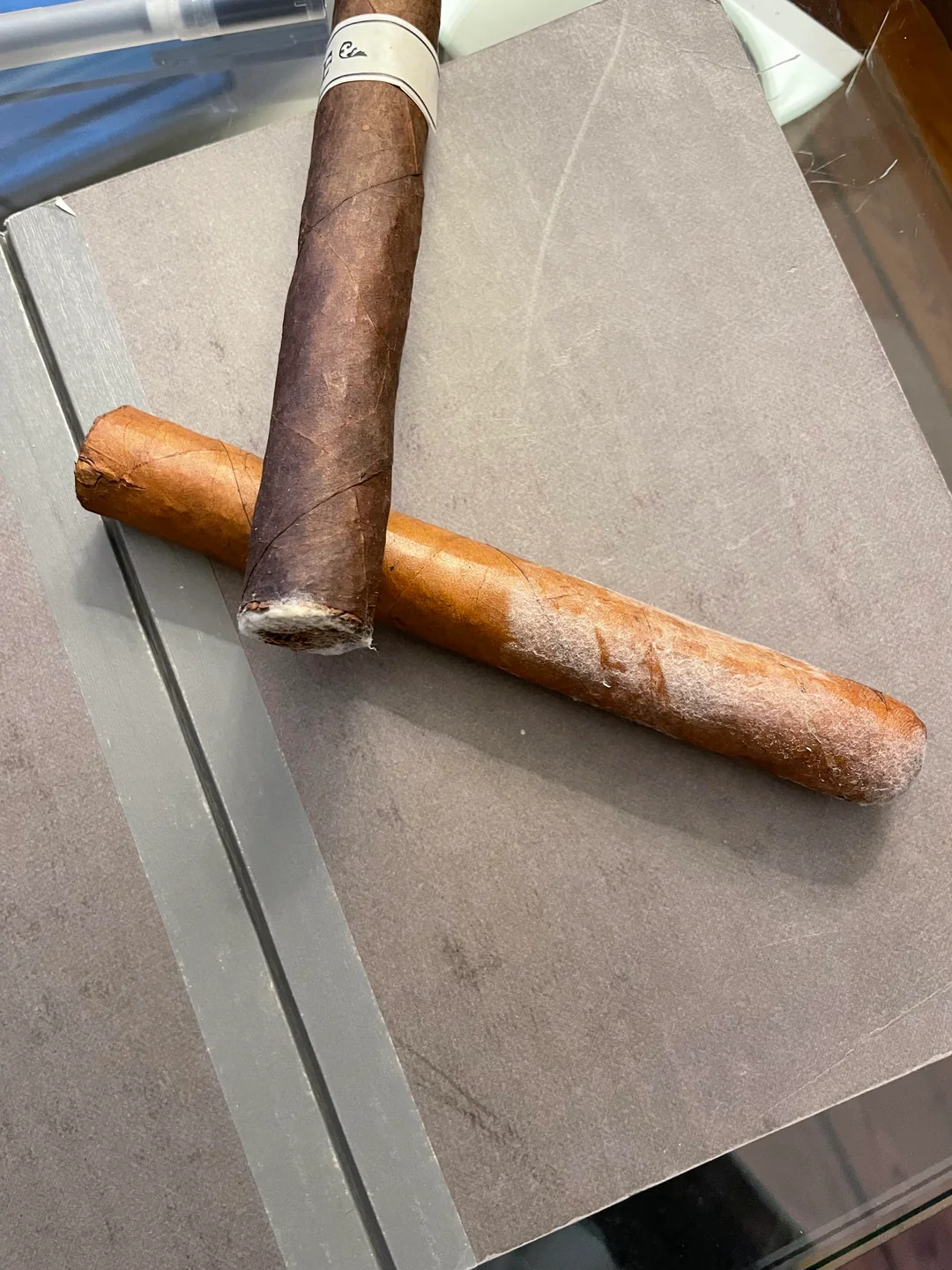
Open the humidor, pull out a cigar, and spot fuzzy bluish-green patches on the wrapper. Your stomach drops. It’s the moment every collector dreads — but before you panic, you need to know what you’re looking at. Half the time it’s not mold at all. The other half, you need to act in the next 24 hours.
Here’s the working aficionado’s guide to identifying mold, separating it from plume, killing it without destroying the rest of your collection, and making sure it never comes back.
Mold vs plume: the distinction that matters
For decades, aficionados treated plume (sometimes called “bloom”) as a badge of honor — a fine, crystalline white dust that supposedly formed when the cigar’s natural oils crystallized on the surface after long aging. Find plume on an old Cohiba and you’d brag about it.
The modern scientific position is less romantic. Multiple lab analyses commissioned by major retailers and reviewers have concluded that what cigar culture calls “plume” is, in nearly every case, a form of harmless white surface mold. The crystalline appearance is just how that particular mold species presents early on. Whether you want to call it plume or benign mold is mostly semantic — the practical question is whether it’s the dangerous kind.
The test is mechanical. Brush the spot gently with a soft cloth or your finger.
- If it wipes off easily and feels like fine powder or dust — it’s plume (or benign white mold). Surface only, no damage to the wrapper underneath, harmless to smoke. Many aficionados consider it a positive sign of well-aged tobacco.
- If it’s fuzzy, sticky, or you have to scrub it — that’s active mold. The hyphae are embedded in the wrapper, the cigar is compromised, and you need to act.
Color helps but isn’t definitive. White is usually fine; greenish-blue or grey is almost always mold; black is mold and usually means it’s penetrated deeply. A musty, locker-room smell coming from the humidor is the other strong indicator — healthy tobacco smells like sweet hay and barnyard, not gym socks.
What actually causes cigar mold
Mold needs three things: moisture, organic material, and warm-enough temperature. Your humidor provides the second by definition. The first and third are within your control.
Humidity above 75% RH for extended periods. This is the primary trigger. A humidor running at 80% all summer is a mold incubator. Even short spikes — leaving a Boveda pack against a wet wrapper, or storing a new arrival that came from a too-humid shop — can seed an outbreak.
Poor airflow. A humidor packed tight with no rotation creates pockets where moisture accumulates. Stacks of cigars touching each other in a sealed environment with no air movement are the conditions any fungus is looking for.
Temperature above 75°F (24°C). Heat speeds up everything biological. A humidor sitting next to a sunny window in July hits mold conditions even at moderate humidity.
Contamination from another cigar. Mold spreads. A single infected stick can seed every cigar it touches within weeks. New arrivals from unknown sources are the most common vector — which is why quarantine matters (more below).
Unclean storage. Wood absorbs spores. A humidor that previously hosted moldy cigars without being deep-cleaned will reinfect every new cigar you put in it. Same goes for travel humidors stored damp in the off-season.
Early warning signs
Mold outbreaks are easier to manage when caught in the first few days. Three things to watch for during your weekly humidor check:
Color anomalies. Greenish-blue, grey, or black spots on the wrapper or foot. Healthy tobacco color ranges from pale Connecticut tan to oily Maduro black — anything outside the normal color spectrum of the leaf deserves a closer look.
Smell. A musty, mushroom-like odor that competes with the natural sweet-hay smell of tobacco. This is usually detectable before visible spots appear.
Texture. Soft, sticky, or damp patches anywhere on the wrapper. A healthy cigar at 65–70% RH feels firm and slightly springy. If it feels squishy or leaves moisture on your fingers, you have a humidity problem brewing whether or not mold has appeared yet.
These checks take 30 seconds during your weekly humidor inspection. Most collectors who lose a collection to mold did so because they only opened the humidor when they wanted to smoke.
The recovery protocol
If you find active mold, work through this sequence within 24 hours. The longer you wait, the more cigars will be compromised.
Step 1: Isolate
Remove every cigar from the affected humidor. Sort them into three piles:
- Visibly moldy — spotted, fuzzy, or smelling musty
- Touching the moldy ones — anything adjacent or stacked against them
- Visually clean — the rest
Get the visibly moldy cigars out of the room entirely. They’re the source.
Step 2: Triage the moldy stock
For each visibly moldy cigar, inspect closely under good light.
Surface mold only, light coverage — small white or pale spots that wipe off completely with a soft dry cloth, leaving the wrapper undamaged. These can sometimes be saved. Wipe carefully, isolate in a separate container at 62% RH for two weeks, and inspect again.
Penetrating mold, sticky spots, or strong odor — discard. No amount of cleaning will recover a cigar where the mold has gone into the binder. The smoke will taste like wet basement and the spores are still alive in the filler.
The hard rule: when in doubt, throw it out. A $20 cigar isn’t worth contaminating a $2,000 collection.
Step 3: Deep-clean the humidor
This is where most recoveries fail. People wipe down with a damp cloth and call it done. Mold spores survive that.
- Empty the humidor completely. Remove the humidification device and any cedar trays or dividers.
- Vacuum out any dust, frass, or debris from the corners and seams.
- Wipe down every interior surface — walls, floor, lid, trays — with a cloth lightly dampened with 91% or higher isopropyl alcohol. Don’t drench the wood; just enough to kill the spores on contact.
- Leave the humidor open in a dry, well-ventilated room for 24 to 48 hours. The alcohol needs to fully evaporate before any cigar goes back in, or the residue will taint your wrappers.
- Re-season the humidor. Use a fresh Boveda 69% or 72% seasoning pack (or a saturated sponge wrapped in cloth — never touching the wood directly) and let the wood come back up to target humidity over 2 to 3 days before reintroducing cigars.
Step 4: Quarantine the survivors
The “clean” pile from Step 1 isn’t necessarily clean — it was just adjacent to mold. Hold these cigars in a separate sealed container at 62–65% RH for at least two weeks, inspecting every few days. Any that develop spots get discarded. The rest can return to the cleaned humidor.
Prevention: the habits that keep mold out
Recovery is expensive and emotionally exhausting. Prevention is mostly free.
Hold the humidor at 65–70% RH. Higher than that and you’re inviting trouble. We covered the full storage framework in our silent keeper guide to cigar storage — humidity, temperature, hygrometer calibration. The 70% RH target many older guides cite is on the edge of the mold-friendly zone in warm rooms.
Use Boveda packs or properly maintained PG units. Boveda’s two-way control system from Boveda won’t push humidity past its rating — a 69% pack literally cannot create a 78% environment, no matter how much you over-stock the humidor. Sponge-based systems with tap water can and will.
Quarantine every new arrival. Two weeks in a sealed container before joining your main collection. Catches both mold and tobacco beetles before they reach the rest of your stock. The same protocol applies after a humidor outbreak — assume everything’s compromised until two weeks pass clean.
Don’t overpack. Leave at least 15% empty space and avoid stacking cigars more than two deep without cedar dividers. Air needs to move, even slowly.
Rotate stock monthly. Move cigars from bottom to top, front to back. Same logic as turning fermentation piles — exposing different sides to the humidity source prevents wet spots.
Wipe down the humidor every few months. A dry cloth, occasionally lightly dampened with distilled water (not alcohol unless cleaning after mold). Catch dust and frass before it sits.
Can you smoke a moldy cigar?
Technically? A small amount of surface mold that wipes off completely won’t poison you. Spores get destroyed at combustion temperatures.
Realistically? No. The flavor is wrecked — moldy cigars taste like damp cardboard with a chemical edge, and the smell on your hands and clothes lingers for hours. Worse, you’re rewarding a behavior (skipping the inspection) that lost you cigars in the first place. Smoke clean, store clean, and move on.
If the outbreak coincided with a humid stretch, also rule out the related nightmare: tobacco beetles. They thrive in the same conditions and a single hatch event can compound the disaster. Our complete guide to cigar beetles covers identification and the freezing protocol.
For the canonical reference on tobacco mycology and humidor science, Cigar Aficionado’s storage guides remain the definitive online source.
Mold in a humidor isn’t a crisis if you catch it early and execute the recovery properly. It is a crisis if you assume it’ll go away on its own — it won’t, and every week you delay costs you more cigars. Keep the RH below 70%, quarantine new arrivals, inspect weekly, and most aficionados will never see a real outbreak. The ones who skip those habits will see one eventually.