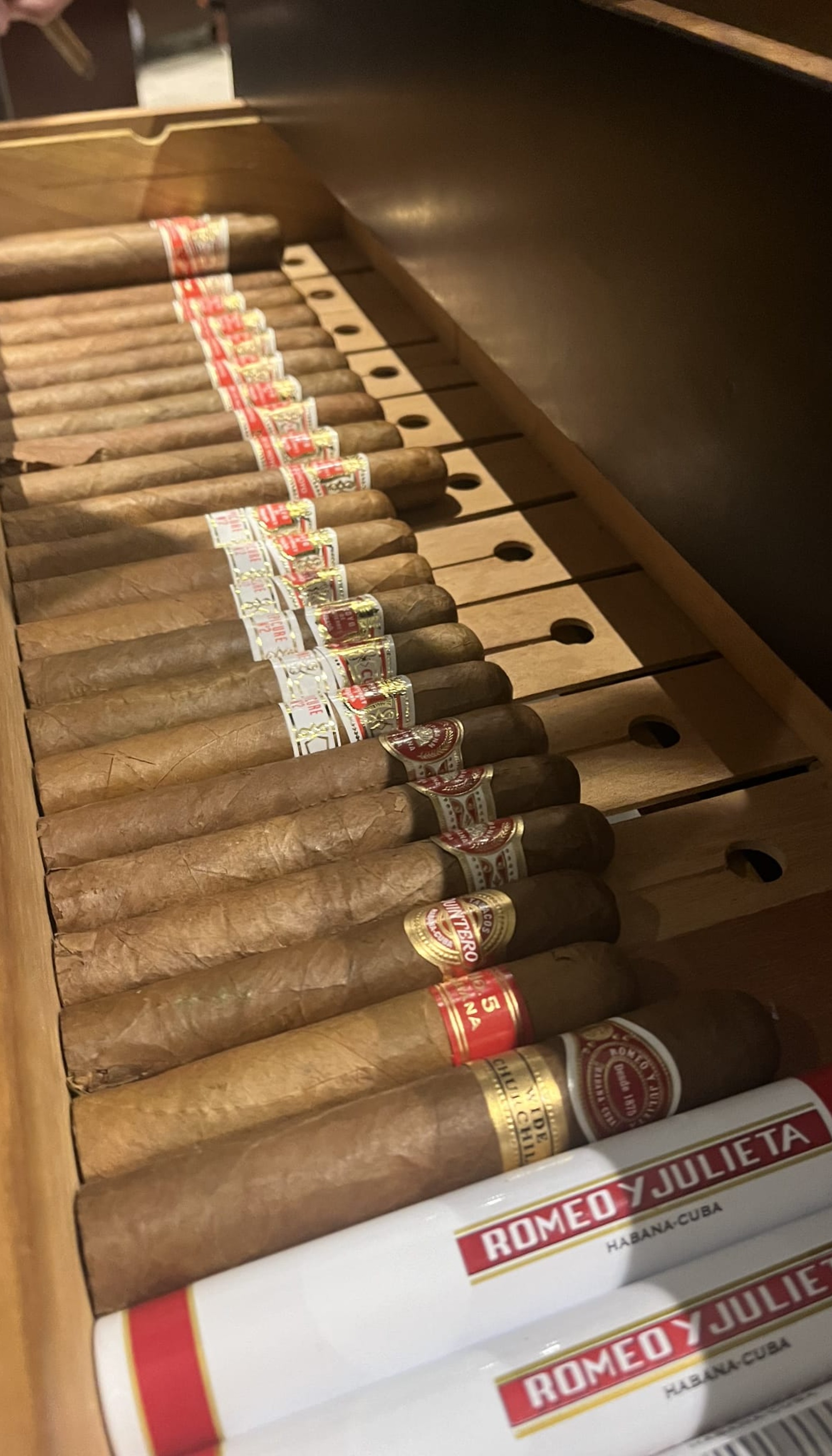
A premium cigar is mostly water. Strip the moisture out and you’re left with brittle leaf that burns hot, tastes harsh, and unravels in your fingers. Push too much moisture in and you’ve engineered a swamp where mold and tobacco beetles thrive. Storage isn’t an afterthought. It’s the entire reason a cigar smokes the way the blender intended six months after it left the factory.
Most cigars that taste disappointing weren’t badly made — they were badly kept. Here’s the working aficionado’s framework for storage, from the first humidor to long-term aging.
The 70/70 rule and why most of us don’t follow it anymore
For decades the standard answer was “70% relative humidity at 70°F” — the so-called 70/70 rule, meant to replicate the tropical climate where the tobacco was grown. It’s a fine starting point, but the modern consensus has shifted lower.
The current target band is 65–70% RH, with 69% as the sweet spot for most collections. Cigars stored at 70%+ smoke wetter — slower burns, occasional self-extinguishing, and a slight sourness that masks the wrapper’s top notes. At 65% RH the cigar feels firmer in the fingers, burns cleaner, and gives you a tighter, more focused flavor. Some collectors store as low as 62% for full-bodied Nicaraguans they want to smoke immediately.
Temperature target: 65–70°F (18–21°C). Below 60°F, fermentation and aging slow to a crawl. Above 72°F, you’ve entered the danger zone — tobacco beetle eggs hatch at roughly 73°F and up, and a single hatch can devastate an entire humidor in days. We covered the consequences in our complete guide to cigar beetles, and it’s the strongest argument for keeping your humidor in a cool, dark spot rather than next to a sunny window.
What dry cigars and wet cigars actually taste like
A dry cigar (below 60% RH for any length of time) burns fast, runs hot, and produces a thin, papery smoke with bitter ammonia edges. The oils that carry flavor have evaporated. Construction suffers — the wrapper cracks, the binder splits.
A wet cigar (above 75% RH for weeks) draws like a straw stuck in mud. The foot won’t stay lit. The smoke tastes muddled and sour. Worse, you’re now one summer week from mold — the topic of our cigar mold guide, where we walk through identification and recovery.
Choosing the right humidor
Storage choice depends on collection size, climate, and how much you want to fuss with calibration. Four categories cover most situations.
Spanish cedar desktop humidors
The traditional setup. A wooden box lined with Spanish cedar — which is naturally beetle-resistant, aromatic, and helps buffer humidity swings. Brands like Quality Importers (the Capri, the Milano), Daniel Marshall, and Elie Bleu cover the range from $80 to several thousand. For most aficionados with a 25 to 100 cigar collection, a mid-range Spanish cedar humidor is the right call.
The catch: wooden humidors must be seasoned before first use, a process where you bring the wood up to target humidity slowly so it doesn’t pull moisture out of the cigars you store in it. Skip seasoning and a brand new humidor will desiccate the first 30 cigars you put inside it.
Acrylic and glass humidors
A modern alternative with a near-perfect airtight seal. No cedar aroma, no seasoning required, very stable humidity. The downside is aesthetic — they look more like Tupperware than furniture. Good for travel, secondary storage, or anyone who finds wooden humidors finicky.
Electric humidors and wineadors
A repurposed wine cooler with cedar shelving and humidity packs inside, or a purpose-built unit from NewAir, Whynter, or similar. Gives you precise temperature control in addition to humidity, which is essential if your home regularly hits 75°F+ in summer. Capacity ranges from 250 to 2,000+ cigars. Expect to spend $300 to $1,500 depending on size and build.
This is the right answer for serious collectors in hot climates or anyone with more than 200 cigars on hand. The temperature stability alone justifies it.
Coolerdors and Tupperdors
The budget hack that actually works. Take an Igloo or Coleman insulated cooler, drop in a few cedar trays and several Boveda packs, and you have a 500-cigar storage solution for under $100. The seal on a quality cooler is better than most $300 wooden humidors. The only downside is appearance — but if you’re storing in a closet, who cares.
For traveling, the Cigar Caddy is the working standard. A foam-padded crushproof case in 5 to 15-stick capacities that holds humidity for a week with a single Boveda pack inside. Throw one in checked luggage with confidence.
Humidification: what to actually put inside
The humidor is the vessel. The humidification source is what does the work.
Boveda packs — the modern default. Two-way humidity control sachets that both release and absorb moisture to hold a precise RH. Sold in 62%, 65%, 69%, 72%, and 75% variants. Drop one in, change every six months. No maintenance, no calibration. The Boveda 69% RH packs are the most-used variant for general storage; go 65% for full-bodied Nicaraguans you want crisp, 72% for Cubans destined for long aging. One large pack handles roughly 25 cigars; scale from there.
Propylene glycol units — the older standard. A foam or crystal-filled cassette saturated with a PG-and-distilled-water solution. Holds humidity at roughly 70% by design and resists mold. Requires periodic refilling. Brands like Credo and Cigar Oasis make reliable units.
Beads and crystals — silica gel calibrated to release moisture at a specific RH (typically 65% or 70%). Recharged with distilled water as needed. Used widely in larger humidors where Boveda volume would get expensive.
What to never use: tap water (mineral deposits and chlorine), unfiltered well water, anything fragranced, or store-bought “humidor solution” of unknown composition. Distilled water only, full stop.
The hygrometer is non-negotiable — and it lies
Every humidor needs a hygrometer to tell you what’s happening inside. Two truths about hygrometers worth knowing.
First, analog dial hygrometers are decorative. The needle-and-spring units that ship with most wooden humidors drift by 5 to 10 points within months. Pretty to look at, useless for actual readings. Replace immediately with a digital.
Second, even digital hygrometers need calibration. The fix is a salt test: place the hygrometer in a sealed bag with a small cup containing a damp slurry of table salt for 8 hours. The bag’s humidity will stabilize at exactly 75% RH. Whatever the hygrometer reads, the offset is your calibration. The Boveda One-Step Calibration Kit does the same thing faster.
Solid digital options for under $30 include the SensorPush HT.w (Bluetooth, app-tracked humidity logs) and the Caliber IV from Western. Anything that costs less than a Boveda pack is probably lying to you.
The habits that separate serious collectors from accidental ones
Owning the gear is half the work. The other half is the maintenance discipline.
Rotate your cigars
Humidors have humidity gradients. The top shelf runs slightly drier than the bottom; cigars near the humidification source sit wetter than those at the far corners. Rotate the stock every month or two — move cigars from the bottom to the top, swap front and back. Aging happens more evenly, and you’ll catch any visual problems before they spread.
Quarantine new arrivals
Cigars from unknown shops, online bulk orders, or anywhere with questionable storage should sit in a separate sealed container for two to three weeks before they meet your main collection. If beetles are going to hatch or mold is going to develop, it’ll show up in quarantine, not in your aged box of Padron Anniversaries.
Some serious collectors freeze every new arrival as a precaution — 24 hours in the fridge, 72 hours in the freezer, 24 hours back in the fridge, then into the humidor. It kills beetle eggs on contact and does no damage to the cigars if you handle the temperature acclimation correctly.
Check weekly, not daily
Pop the humidor once a week, look at the hygrometer, eyeball a few cigars for anything off (color spots, soft patches, pinholes), and close the lid. Daily checks are obsessive and counterproductive — every time you open the humidor you’re releasing humidity and forcing the system to recover.
Don’t overfill
A humidor packed to capacity has poor air circulation, which encourages humidity pockets and makes mold more likely. Leave at least 15% empty space, and avoid stacking cigars more than two layers deep without cedar dividers between them.
When your cigar lifestyle gets serious
Storage is the foundation but not the destination. Once you’ve got a stable humidor running, the next layer is the smoking gear — the cutter, the lighter, the travel case. Our lifestyle pieces worth owning covers what’s actually useful versus what’s just expensive.
For the canonical reference on tobacco preservation, the Cigar Aficionado humidor guide goes deeper on long-term aging and vintage storage.
A great cigar doesn’t survive bad storage. A mediocre cigar improves dramatically under good storage. The silent keeper isn’t the humidor itself — it’s the discipline of paying attention to the small things, every week, for years. Get that right and every cigar you pull out smokes the way it was supposed to.