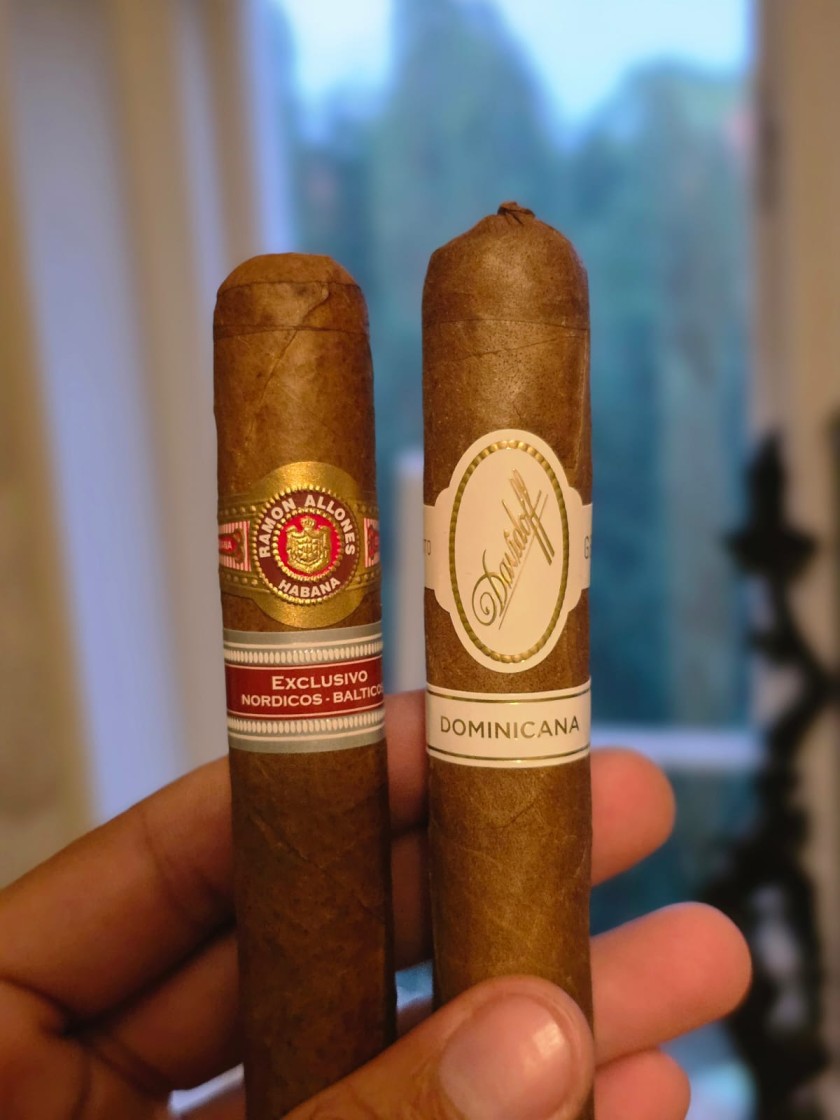
The wrapper is the most expensive leaf on a premium cigar. It contributes roughly 60% of the perceived flavor despite making up less than 5% of the cigar’s tobacco by weight. It’s also the first thing you see, the first thing you touch, and the last thing your palate meets before the smoke begins. So when smokers argue about Cuban versus Dominican cigars — and that argument has been running since 1962 — what they’re really arguing about is wrapper leaf.
Both islands sit in the same Caribbean latitude band. Both grow tobacco descended, ultimately, from the same Cuban seed stock. Both produce some of the best wrappers in the world. And yet the two leaves taste, draw, and age differently enough that an experienced smoker can identify which is which blind from a single puff. The reasons are part soil, part climate, part fermentation philosophy, and part the political accident of 1959.
The Cuban leaf and the Vuelta Abajo
Cuba’s wrapper production is concentrated in a single region: the Vuelta Abajo, a strip of red-clay farmland in the western Pinar del Río province roughly 100 miles long and 30 miles wide. Within Vuelta Abajo, the most prized wrapper land sits in the municipalities of San Juan y Martínez and San Luis — a few thousand hectares of soil that produce the leaf wrapped around essentially every flagship Habano.
The land matters. The red clay is iron-rich, low in calcium, and drains in a particular way during the November-to-February dry season that allows the tobacco to develop concentrated leaf chemistry. Average rainfall during the growing cycle sits at 1,400-1,600 mm. Diurnal temperature swings are sharp — afternoon highs of 28-30°C dropping to overnight lows around 15°C. Those swings drive the slow alkaloid accumulation that gives Cuban tobacco its characteristic depth.
The Cuban wrapper seed varieties
Most Cuban wrapper leaf comes from one of three seed lines, all of which trace back to traditional Cuban genetic stock:
- Corojo ‘99. A modern Cuban hybrid developed to resist blue mold while preserving classic Cuban flavor. Now the dominant wrapper seed for Habanos production.
- Criollo ‘98. Originally bred for filler use but increasingly used as wrapper in selected blends. Sweeter, slightly more delicate than Corojo.
- Habano 2000. Another mold-resistant cultivar from the late 1990s. Used in regional editions and several Limitada releases.
The wrappers grown from these seeds are sun-grown, which gives them a thicker leaf with more pronounced veining and the characteristic oily sheen of a well-cured Cuban wrapper. Sun-grown leaves carry more nicotine and more concentrated volatile compounds — the source of what smokers call the “Cuban twang,” a faintly sour, mineral note that sits underneath the cedar and spice. Habanos S.A. publishes seed-by-seed information for some of its premium releases, and the seed varietal is increasingly a part of how serious collectors evaluate vintage stock.
Fermentation, Cuban style
Cuban fermentation is slow. After harvest, leaves are cured in barns for 45-60 days, then bundled into pilones — large stacks of leaf bundles — for the first fermentation. The pilón reaches internal temperatures of 40-45°C; once it cools, the stack is broken down, rotated, and rebuilt. The cycle repeats two to four times across 12-24 months.
That slow, hands-on fermentation is part of why Cuban wrappers taste the way they do. The lengthy process drives off the harshest ammonia, deepens the leaf’s color toward the colorado range, and develops the complex secondary flavors — cedar, leather, baking spice, roasted coffee — that the Cuban profile is known for. Skip steps to save time, and the leaf shows it.
The Dominican leaf and the Cibao Valley
The Dominican wrapper story starts in 1959, when Cuban planters fleeing the revolution carried seed stock to the Dominican Republic. The Fuente, Padrón, and several other major Cuban tobacco families re-established themselves there, primarily in the Cibao Valley — a broad inland plain stretching from Santiago through Moca and into La Vega.
The Cibao isn’t Vuelta Abajo. The soil is darker, more alluvial, higher in calcium. Rainfall is higher (around 1,800-2,000 mm in the growing zones). The temperature range is narrower — fewer of those sharp diurnal swings that drive Cuban leaf chemistry. The resulting tobacco is, by chemistry alone, milder. Less nicotine concentration, less of the mineral edge, more of the natural sweetness that comes from a calcium-rich soil.
Dominican wrapper production is more diversified than Cuba’s. Several distinct micro-regions produce wrapper-grade leaf:
- Cibao Valley sun-grown. Used by Fuente, La Aurora, and others for the rounded, slightly sweet Dominican wrapper profile.
- Bonao shade-grown. Davidoff and several boutique brands source shade-grown wrappers from this higher-elevation zone, producing a paler, silkier leaf reminiscent of Connecticut shade.
- San Vicente. Where Fuente cultivates the rare wrapper used on the Fuente Fuente OpusX — the first 100% Dominican puro to seriously rival Cuban cigars at the top of the market.
Dominican seed and fermentation
Most Dominican wrapper seed traces back to Cuban genetics, but several decades of selective breeding in Dominican soil have produced distinct cultivars. Cuban Seed Olor and Piloto Cubano are the two most important Dominican wrapper varieties — Cuban genetics adapted to Cibao conditions over multiple generations.
Fermentation in the Dominican Republic tends to be faster and more aggressive. Larger pilones, higher peak temperatures (sometimes 50°C), shorter total cycles — often 8-14 months versus the Cuban 18-24. The result is a smoother, less mineral-heavy leaf. Some smokers read this as a positive — a wrapper that’s polished, refined, easy to pair. Others read it as a loss of the slow-developed complexity that defines old-school Cuban tobacco.
Neither read is wrong. The two leaves are aimed at different palates.
What the cigars actually taste like
The differences are most visible side by side, at the same vitola, lit within minutes of each other.
A Cuban wrapper — say the colorado on a Hoyo de Monterrey Epicure No. 2 — opens with cedar and a faint sourness that resolves into leather, espresso, and a peppery finish. The mineral edge persists through the smoke. The cigar tends to gain strength through the second third, peaking in the final third before the zona caliente near the band.
A Dominican wrapper — the natural on a Fuente Fuente OpusX or the Cameroon on an Arturo Fuente Hemingway — opens with cocoa, cream, and toasted nuts. The mid-third moves toward dark chocolate and a faint sweetness rather than the mineral edge. The final third stays balanced rather than escalating; Dominican blends generally don’t deliver the late-cigar strength surge that Cuban blends do.
Neither is universally better. The relevant question is what you want from a cigar at the moment you’re lighting one.
Construction and consistency
Cuban production is centralized under Habanos S.A. and has a documented history of inconsistent quality control. Plugged draws, uneven burns, soft spots — the issues that come from a state-managed industry with limited price competition show up in roughly 10-15% of any given box, depending on factory and year. Recent investment under the Allied Cigar joint venture has improved the situation, but the gap to Dominican consistency hasn’t fully closed.
Dominican manufacturers — Fuente, Davidoff, Tabacalera de García (the Altadis-owned factory that produces Romeo y Julieta, H. Upmann, and Montecristo for the non-Cuban market) — compete in a free market and enforce tighter quality control. Plugged draws are rare. Burn lines are even. Construction is dependable in a way Cuban production sometimes isn’t.
This is the unspoken trade-off when buyers pay the Cuban premium: you’re paying for terroir and for the gamble that the cigar will perform. Most of the time it does. When it doesn’t, you’ve spent $30 on a cigar that won’t draw.
Availability and price
Cuban wrappers exist only on Cuban cigars. They aren’t exported as loose leaf — the Cuban government strictly controls the supply chain, and the embargo prevents legal Cuban cigar sales in the US entirely. European tobacconists charge €15-40 for standard Habanos vitolas, with limited editions reaching €100+ per stick.
Dominican wrappers ship around the world freely. They appear on cigars from $5 daily smokes to the $35 Fuente Fuente OpusX and the $45+ Davidoff Royal Release. The value spread is enormous, and a careful buyer can find Dominican wrappers at every price point. The same isn’t true of Cuban.
Which leaf for which moment
The choice usually breaks down by occasion and tolerance for variability:
Reach for a Cuban wrapper when you want the classic profile — the mineral edge, the late-cigar strength climb, the leather-and-cedar character that defined cigar smoking for two centuries. Accept that you might get a plugged draw once a box. The historical depth is the point.
Reach for a Dominican wrapper when you want a guaranteed well-made cigar, polished construction, and a flavor profile that tends toward cream, cocoa, and refinement rather than mineral and earth. Dominican leaf is also the right answer for anyone smoking in the US, where Cubans remain legally inaccessible.
The honest position: both islands produce world-class wrapper leaf. The 1959 diaspora was a tragedy for Cuba and a windfall for the Dominican Republic, and the modern premium market is better for having both products available. Anyone who tells you Cuban is always better, or Dominican is always more consistent, is overselling a position that the wrapper leaves themselves don’t support. What matters is reading the cigar — origin, vitola, vintage, filler construction — and choosing one that matches the smoke you want at that moment.
The wrapper started the conversation. Where it ends is up to you.