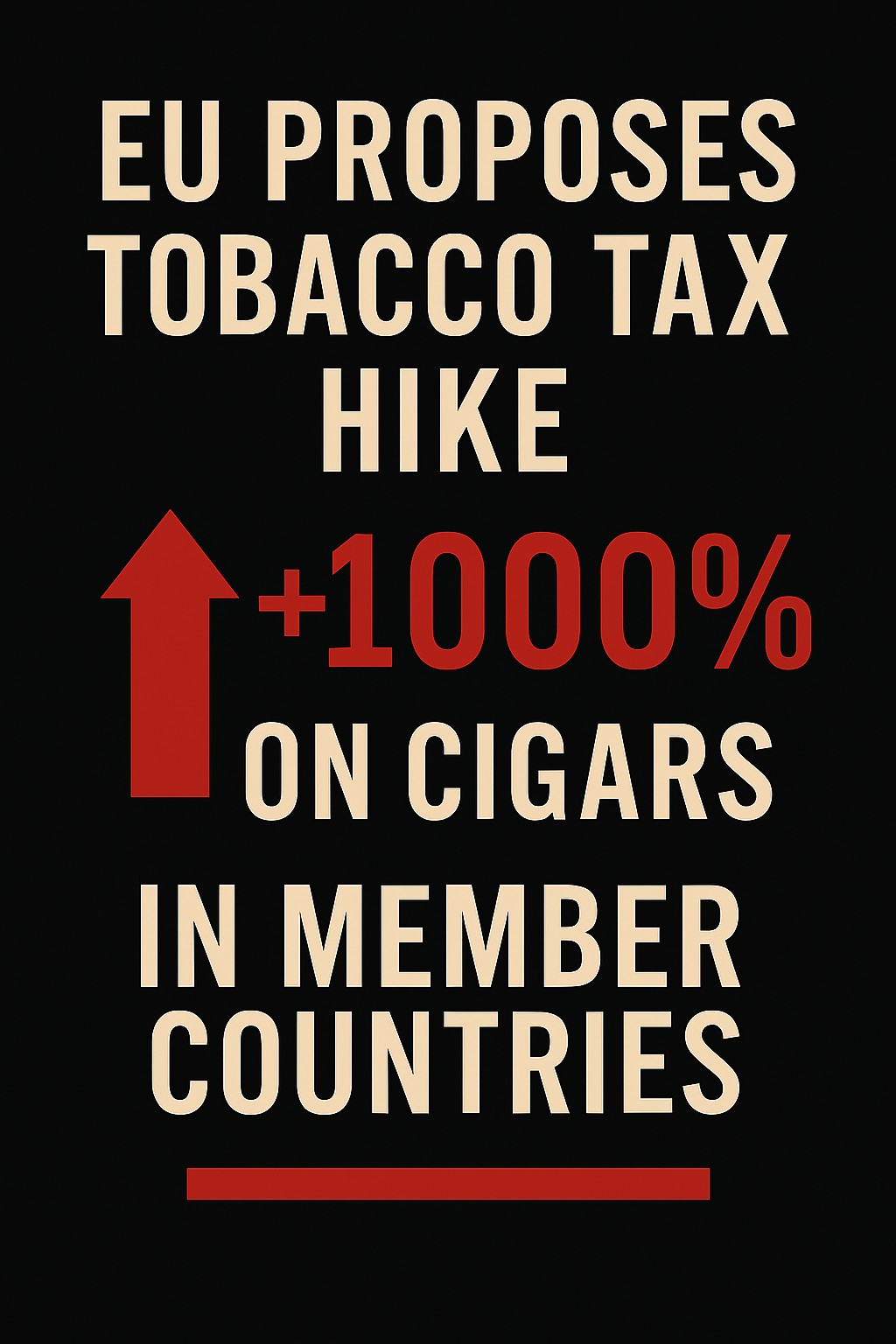
On July 16, 2025, the European Commission published its proposed revision of the Tobacco Excise Directive (Directive 2011/64/EU) — the framework that has set minimum tobacco excise rates across the European Union since 2011. The headline for cigarette smokers is dramatic enough. The headline for cigar smokers is a different conversation entirely: the minimum excise on cigars and cigarillos would rise by up to 1,100% in member states currently sitting at the floor.
If this directive passes in anything close to its current form, the European cigar market that smokers across the continent have spent the last twenty years getting used to ends. The question — and the reason this post sits alongside our deeper coverage of the TPD3-era cigar tax shake-up — is whether Brussels can actually get it through.
What the proposal actually does
The directive operates on the same logic as the existing framework: Brussels sets a minimum rate that every member state must apply. States can tax higher, and many do. None can go lower. The proposal updates those minimums sharply across four product categories:
- Cigarettes: minimum excise raised by up to 139% of the current floor.
- Roll-your-own tobacco: minimum excise raised by up to 258% of the current floor.
- Cigars and cigarillos: minimum excise raised by up to 1,100% in markets currently at the floor.
- Novel products — heated tobacco, e-cigarettes, nicotine pouches — pulled under EU-wide minimums for the first time, closing the gap that has let Sweden’s snus and the disposable-vape category operate under fragmented national rules.
The Commission’s accompanying impact assessment projects €15 billion in additional annual EU tax revenue and €6 billion in cumulative healthcare savings. Whether those figures hold depends on the underlying public-health bet: that higher prices cut consumption rather than shifting it to the black market. Industry submissions argue the latter; the Commission’s modelling assumes the former.
Why cigars catch the worst of it
The 1,100% figure is the one that has driven the most pushback, and it deserves the most context. Under the current 2011 directive, member states are permitted to tax cigars below the cigarette-equivalent floor on the historical reasoning that premium cigars are luxury goods consumed in materially smaller volumes by older demographics with a different public-health profile from cigarettes. That carve-out has been preserved across every revision since the original 1995 directive.
The 2025 proposal removes the carve-out. It treats cigars and cigarettes as equivalent products for the purpose of setting the minimum tax-per-stick floor. For high-tax markets like France, Ireland and Denmark, the impact is small — they already tax above the proposed new floor. For low-tax markets like Sweden, Portugal, Italy, Bulgaria and the Czech Republic, the percentage increase is enormous, even if the absolute cash impact on a single €20 Habano is “only” a few extra euros per stick.
The math runs through the channel. A box of 25 Cohibas that currently retails at €400 in a low-tax market would, on the Commission’s own working figures, rise into the €500–€700 band depending on how each member state implements within the new floor. For La Casa del Habano franchises and Habanos Specialists in those markets, the impact on box velocity at the new pricing is not marginal — at that price level, demand stops behaving like demand for a tobacco product and starts behaving like demand for a discretionary luxury good, which is materially more elastic.
The cross-border shopping pattern that has shaped European cigar smoking for two decades — the Berlin run, the Spain trip, the duty-free routing through the lower-tax markets — was built on those tax-floor differences. Harmonised floors close that pattern in a single move.
Who is actually pushing back
The directive requires unanimous approval in the Council of the European Union. Any single member state can block it. The opposition lines have formed faster than the Commission anticipated:
- Sweden is the loudest opponent, on snus grounds rather than cigar grounds. The country’s harm-reduction strategy is built around a smokeless category the directive would directly target, and the Swedish position is publicly that the proposal is incompatible with the national public-health framework.
- Italy opposes on small-producer protection. The Tuscan cigar tradition — most prominently the Toscano category — would be disproportionately affected by a cigar floor calibrated against mass-market cigarette pricing, and Italian industry advocates have been vocal in Brussels.
- Greece, Portugal, and Bulgaria have raised national tax sovereignty objections.
- Germany and France have signalled openness in principle while pushing for substantial revisions to the cigar treatment specifically.
The push for the directive comes from the Europe’s Beating Cancer Plan coalition and the northern European public-health bloc, which views harmonised excise as the most effective remaining tool for reducing consumption EU-wide. The European Cigar Manufacturers Association has called the proposal disproportionate and is lobbying at the member-state level rather than at the Brussels level — which is the right read of where the directive will actually live or die.
What happens next: three realistic scenarios
Scenario one: the directive passes substantially intact. Sweden, Italy or another opposing state trades a vote against the directive for concessions on an unrelated EU file. European retail cigar prices rise 30–60% by 2028. This is the Commission’s preferred outcome and the industry’s worst case.
Scenario two: the directive passes with a cigar carve-out. This is the cigar industry’s preferred outcome. Cigarette and roll-your-own minimums rise as proposed; cigar floors stay close to current levels, on the public-health argument that premium cigars represent under 1% of EU tobacco consumption by volume and aren’t a meaningful contributor to the consumption pattern the directive is trying to change.
Scenario three: the directive stalls. Sweden’s opposition holds, unanimous approval is not achieved, and the Commission re-tables a watered-down version. This is what happened in 2014 with the previous attempt at full harmonisation. The 2025 proposal is more ambitious, which makes a complete stall less likely than a heavily revised final text — but historical precedent for stall scenarios is real.
The proposed transition runs four years from adoption, with full implementation targeted for 2028 if approved. That is the window European aficionados need to plan within.
What to do now
For European premium cigar smokers, three practical moves make sense in 2026:
- Buy boxes you intend to age, now. The supply chain is already pricing in regulatory risk — wholesale Habanos pricing in EU markets has crept up over each of the last three Habanos S.A. price revisions. Inventory acquired at 2026 prices and properly stored will be materially cheaper than 2028 retail under any non-stall scenario. The collector’s guide to vintage cigars covers the storage setup needed to age boxes responsibly.
- Keep receipts on high-value purchases. The directive bundles in tightened raw-tobacco anti-illicit-trade enforcement, and the casual cross-border carrying that has long been tolerated in personal-use quantities will face stricter scrutiny in any tightened framework. Documentation matters more in 2027 than it has in 2007.
- Watch national implementation, not just the Brussels text. Member states retain latitude in how they implement EU directive floors. Sweden and Italy will, if forced to implement, almost certainly do so at the slowest pace and lowest practical national rate. Your specific market trajectory depends on the choice your government makes within the directive’s framework — which means national elections matter to your humidor.
The broader strategic context: the post-Imperial Brands ownership change at Habanos S.A. is already pushing premium Cuban cigar prices upward at the corporate level, independently of any EU regulatory move. The combined effect — corporate premiumisation plus harmonised tax floors — is a structurally more expensive European cigar market over the next five years, even in the stall scenario. For the parallel US market dynamic, our reporting on US cigar industry trends and growth shows the opposite pressure: American imports are rising while Europe is bracing for contraction.
For deeper coverage of the cross-border shopping era and what its closure means for Nordic and Scandinavian buyers specifically, our follow-up on the new EU directive’s full impact goes further on consumer impact than this preview does.
The European cigar market of the last twenty years was built on a particular accident of regulatory history — forgiving tobacco-tax floors set in 1995 and only partially updated since. This directive proposes to end that accident. Whether it succeeds depends on a small number of national vetoes and on how hard the trade pushes through 2026 and 2027. We will track member-state positions as they firm up. Bookmark the page; subscribe to the Sunday newsletter for the directive updates as they move through the Council.