My Cigar Selection : A Leader's Guide to Shape, Size, and Shade
A practical guide to cigar selection — how shape (vitola), size (length and ring gauge), and wrapper color shape your smoke. The framework you actually need at the humidor.
The first time you stand in a walk-in humidor it can feel like staring at a foreign-language menu. A wall of cigars in every length, thickness, color, and shape, most of them looking superficially similar, all of them costing different amounts of money for reasons that aren’t obvious. The instinct is to ask the tobacconist what’s good. That works once. After that, you need a framework — one that lets you read a cigar correctly before you’ve ever lit it.
Three variables do most of the work. Shape — the vitola, the silhouette of the cigar in your hand. Size — length in inches, ring gauge in 64ths of an inch. Shade — the color of the wrapper, which signals fermentation, priming position, and flavor character. Get these three sorted and you can walk into any humidor in the world and read the shelves like a menu you actually understand.
A note before the framework: there is no consistent relationship between size and strength. A small petit corona from one brand can be more powerful than a Churchill from another. Strength comes from the blend — the proportions of Volado, Seco, and Ligero primings in the filler, plus the wrapper character — not from the shape. Shape, size, and color tell you about the type of smoke you’re going to have. The blend tells you about the intensity.
The architecture of a cigar: vitola and shape
Every cigar fits in one of two structural categories: parejos, the straight-sided format that defines roughly 90% of the market, or figurados, the irregularly shaped cigars that show off a roller’s technical skill.
Parejos: the straight-sided standards
A parejo has parallel sides, a rounded head (the end you cut), and an open foot (the end you light). The category breaks down by length and ring gauge into a vocabulary that’s been remarkably stable since the late 19th century:
- Petit Corona. 4 1/2 inches, 40-42 ring gauge. A 30-minute smoke. The format for a quick after-lunch cigar, particularly in the Cuban portfolio (Bolívar Petit Coronas, Hoyo de Monterrey Le Hoyo du Prince). Underrated as a way to understand a blend without committing 90 minutes.
- Corona. 5 1/2 to 6 inches, 42-44 ring gauge. The classic benchmark vitola — what most cigars looked like before the 1990s ring-gauge inflation. A balanced, slow smoke that lets the wrapper carry significant influence over the blend. Ramón Allones Small Club Corona is one of the canonical examples.
- Lonsdale. 6 1/2 inches, 42 ring gauge. Longer than a corona, narrower than a Churchill — historically a popular European format. Slightly fallen out of fashion but a good vitola for collectors looking at vintage stock.
- Robusto. 4 3/4 to 5 1/2 inches, 48-52 ring gauge. The dominant size in the modern US market and increasingly worldwide. Full flavor in a 45-60 minute format. Ramón Allones Specially Selected is the Cuban benchmark; Padrón 1964 Anniversary No. 4 is the New World equivalent.
- Toro / Corona Gorda. 5 5/8 to 6 inches, 46-52 ring gauge. The format that surpassed the robusto in popularity in the 2010s. Longer smoke, slightly cooler combustion, more room for the blend to evolve. Joya de Nicaragua Antaño 1970 Gran Consul is a representative example.
- Churchill. 7 inches, 47 ring gauge. Named for Winston Churchill, who smoked Romeo y Julieta Churchills daily through World War II. A 90-minute commitment — the right format for an unhurried evening, not for a 20-minute break.
- Lancero / Panetela. 7 to 7 1/2 inches, 34-38 ring gauge. Long and thin. Because the wrapper makes up a larger proportion of the cigar at narrow ring gauges, lanceros showcase wrapper flavor more than any other format. Loved by purists. Oliva Serie V Liga Especial Lancero is a top pick.
- Gordo / Grande. Variable length (typically 5 1/2 to 6 1/2 inches), 60+ ring gauge, sometimes reaching 70-80. The big-format category that emerged in the early 2000s and now dominates American retail. The thick ring gauge produces cool, slow combustion that emphasizes the filler blend over the wrapper. The rise of the heavy ring gauge is one of the genuine structural shifts in the modern market.
Figurados: the technical formats
Figurados are harder to roll and command higher prices for it. Most premium brands include at least a few figurado offerings, and the technical demand on the torcedor — the cigar roller — is real. A skilled roller working on a piramide produces 30-40% fewer cigars per day than the same person rolling parejos.
- Piramide. Tapered head coming to a point, open foot widening to standard ring gauge. The taper concentrates smoke at the head, which heightens flavor perception on the palate. Montecristo No. 2 is the legendary example — a 6 1/8 inch piramide that has anchored the Cuban portfolio since 1935.
- Belicoso. Shorter than a piramide, traditionally with a slightly rounded rather than sharp point. Modern Belicosos are often built closer to a robusto with a tapered head. A concentrated, intense smoke.
- Torpedo. Technically distinct from piramide — a torpedo traditionally has a closed foot and a pointed head, with a slight midsection bulge. In modern usage, “torpedo” and “piramide” are often used interchangeably, though purists differentiate.
- Perfecto. Closed foot, bulged middle, tapered head. The ring gauge changes through the length of the cigar, which means the draw and flavor profile shift dramatically as you smoke. A roller’s showcase format. Fuente Fuente OpusX Perfecxion No. 1 is the modern Dominican benchmark.
The substance: length, ring gauge, and what they do
Size on a cigar is two numbers, always: length in inches, ring gauge as the diameter measured in 64ths of an inch. A 50-ring-gauge cigar is 50/64ths of an inch thick, or roughly 19.8mm. A 60-ring cigar is 60/64ths, roughly 23.8mm.
The effect of these numbers on the smoking experience is direct:
Ring gauge controls combustion temperature and the wrapper-to-filler ratio. A thin cigar (34-38 ring) burns hotter and faster, and the wrapper makes up a larger proportion of the total tobacco — so wrapper flavor dominates. A thick cigar (50+ ring) burns cooler and slower, and the filler blend dominates because there’s proportionally less wrapper.
Length controls how long the cigar lasts and how much room the blend has to evolve. A petit corona delivers 25-35 minutes. A robusto, 45-60. A toro, 60-90. A Churchill, 75-120. The longer the cigar, the more the blend can shift through its phases — most premium long-format cigars are blended to deliver distinct first-third, second-third, and final-third character.
Neither variable, on its own, signals strength. A thin lancero rolled with a Ligero-heavy blend can be considerably more powerful than a fat gordo rolled with mostly Volado. The dimensions tell you about the smoking experience; the blend tells you about the intensity.
The complexion: wrapper color
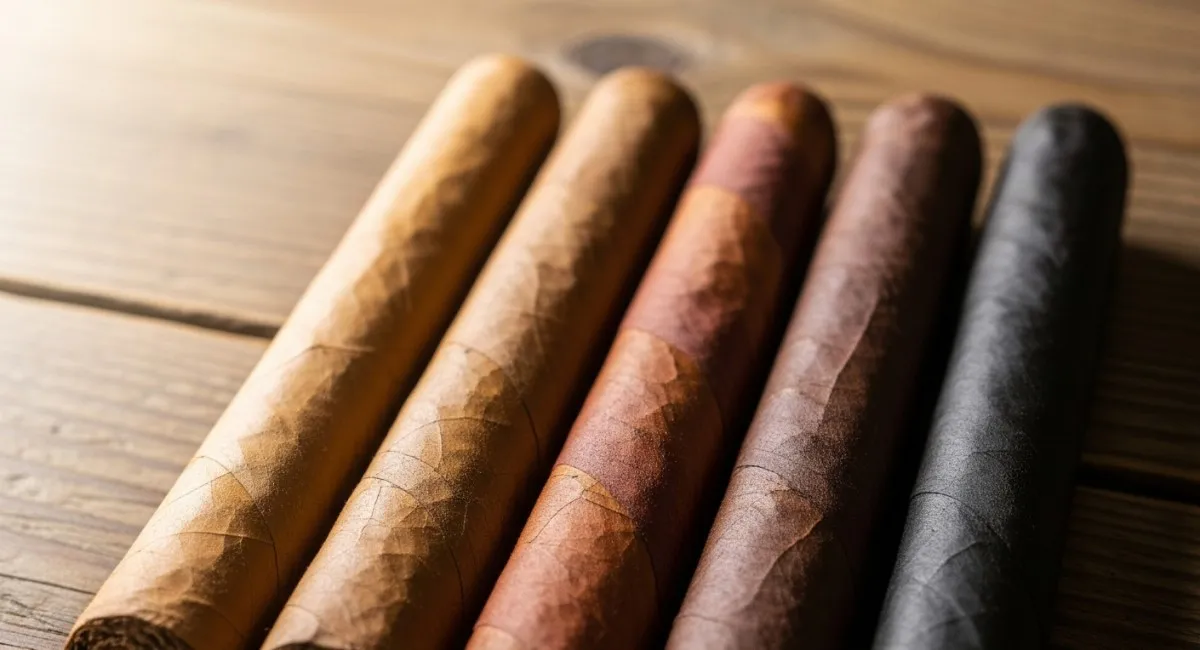
The wrapper is the most expensive component on the cigar — typically 60% of the perceived flavor on a premium handmade. Wrapper color signals priming position (where on the plant the leaf grew), curing and fermentation duration, and seed varietal. The standard color taxonomy runs from palest to darkest:
The wrapper shade scale
- Claro / Connecticut Shade. Light tan, sometimes with a greenish cast. Shade-grown — typically under cheesecloth tents that filter direct sunlight, producing a thinner, paler leaf. Mild, creamy, with notes of hay, cedar, and toasted nuts. The wrapper used on Davidoff classics and many mild Dominican blends.
- Colorado Claro / Natural. Light golden-brown. Sun-exposed but lightly fermented. Nutty, cedary, with more spice than a Claro. The standard wrapper on many Dominican and Honduran cigars.
- Colorado. Medium brown with a distinct reddish hue. Longer fermentation than a Natural. Smooth, aromatic, with notes of sweet spice and earth. The classic Cuban wrapper color for most of the Habanos portfolio.
- Colorado Maduro. Darker than Colorado but not as dark as a true Maduro. Richer and more aromatic, often balancing spice with sweetness. Many Nicaraguan flagship blends sit in this color range.
- Maduro. Spanish for “ripe.” Very dark brown to nearly black. The color comes from extended fermentation — sometimes 18+ months — and from selecting higher-priming leaves with more natural sugars. Rich, often sweet, with dark chocolate, coffee, and pepper notes. San Andrés Negro from Mexico is the classic Maduro source; Connecticut Broadleaf is the North American equivalent.
- Oscuro. The darkest wrapper category, nearly black. Made from the highest-priming leaves (often Ligero-position), fermented for very long durations. Concentrated and powerful — espresso, black pepper, dark earth. The Punch Rare Corojo Oscuro and the darker Padrón maduros sit in this range.
A note on the color-equals-strength myth: darker wrappers are usually stronger, but not always. The wrapper contributes some strength, but most of the cigar’s nicotine load comes from the filler. A dark Oscuro wrapper over a Volado-heavy filler can be milder than a Claro wrapper over a Ligero-heavy filler. Read the band, ask the tobacconist, or check a credible review on Halfwheel before assuming color predicts intensity.
Putting the framework together
The three variables work as a tool, not a formula. A useful way to use them:
For a quick smoke (under 45 minutes): petit corona or robusto, any wrapper color matched to your preference, ring gauge 42-52.
For an unhurried evening: toro or Churchill, ring gauge 46-50, wrapper in the colorado-to-maduro range where most premium blends sit.
For a wrapper-forward experience: lancero or panetela, ring gauge 34-38, where the wrapper character dominates the blend.
For a filler-forward experience: gordo or grande, ring gauge 60+, where the filler architecture carries the cigar.
For introducing someone to premium cigars: corona or robusto, claro or colorado claro wrapper, mild-to-medium blend. Avoid the temptation to hand a beginner a Padrón 1964 Anniversary Maduro and assume bigger is better.
For a serious tasting evening: pick a single blend across multiple vitolas — a Padrón Anniversary 1964 in robusto, toro, and Churchill, say — and smoke them in sequence. The same blend in different sizes is one of the cleanest demonstrations of how shape and size affect a smoke.
What the framework doesn’t replace
This is a starting framework. It doesn’t replace the deeper variables — puro versus blended construction, Cuban versus New World terroir, vintage, aging condition. Those become relevant once you’ve moved past “what should I buy” into “what should I add to my humidor.” But for the actual moment of selection — standing in the lounge, picking a cigar for the next hour — shape, size, and shade are the three variables that do most of the work.
Read the cigar. Match it to the time you have, the mood you’re in, and the strength you can handle. Then cut it cleanly, light it slowly, and pay attention to what it tells you. The framework gets you to the right cigar. The cigar does the rest.
Filed under
Cigar 101