Front page · Magazine · Cigar 101
Cigar 101
How to Read a Cuban Cigar Box: Seals, Stamps, Codes and the One Tell That Never Lies
Turn the box over. Two marks burnt into the cedar, two inked underneath, a warranty seal with a hologram and a barcode, a chevron on the lid. What each one says, what it cannot say, and why the price on the board is the tell forgers can't fake.
By Cristian Ortiz Suárez 15 September 2026 7 min read
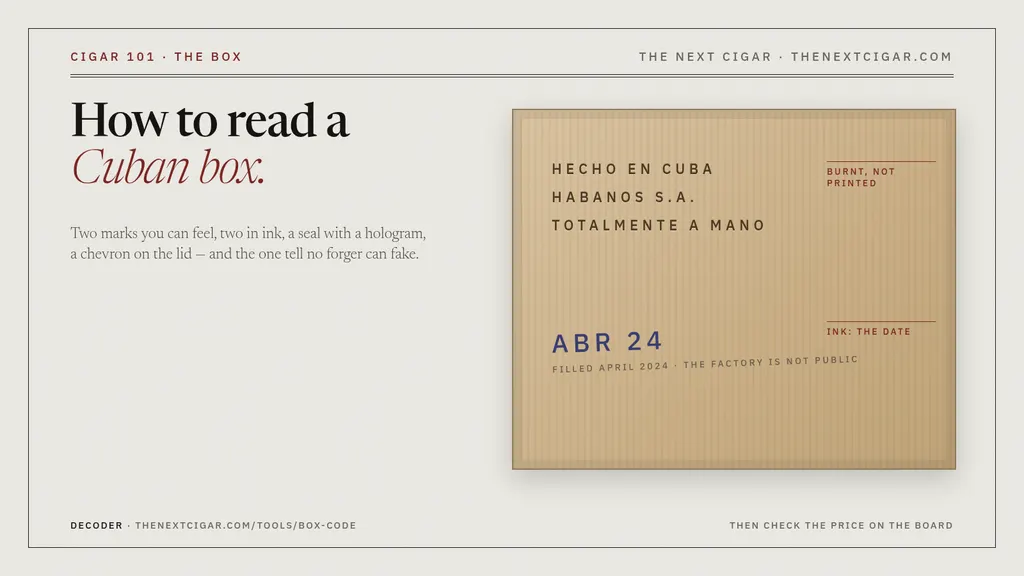
Every box of Habanos that has reached a shop legally since 1994 carries the same set of marks, and every forger in the world has a copy of that set. So the first thing to understand about reading a Cuban box is what the marks are for. They are not a lie detector. They are a passport: they tell you where the box says it came from, when it says it was filled, and whether somebody has interfered with it since. A good passport can be forged. What cannot be forged is the economics of the thing, and I will get to that at the end, because it is the part every guide leaves out.
Here is the box, mark by mark, in the order I read it at a counter.
1. Turn it over: the marks you can feel
On the underside of the box, three phrases are burnt into the cedar with a hot stamp, not printed: Hecho en Cuba (used since about 1960), Habanos s.a. (since 1994, when the company replaced Cubatabaco as the marketer of Cuban cigars) and Totalmente a Mano (since 1989, when it replaced Hecho a Mano; it means wholly by hand). Run a fingernail across them. Genuine stamps are pressed into the wood and you feel the edge. A cheap counterfeit prints them flat, in the wrong typeface, sometimes with a spelling that would embarrass a first-year Spanish student. If the wood is smooth under the letters, put the box down.
A small inked TC next to those marks means tripa corta, short filler; it has been used since 2002 and appears on machine-finished and short-filler lines, never on the hand-rolled long-filler boxes that people pay Cohiba money for.
2. The ink: the date and the factory
Two ink stamps sit under the burnt marks. One is the date the box was filled, not the harvest: since 2000 it is a three-letter Spanish month and a two-digit year. ENE, FEB, MAR, ABR, MAY, JUN, JUL, AGO, SEP, OCT, NOV, DIC. ABR 24 is April 2024. Cuban leaf is fermented and rested for a year and a half or two before it is rolled, so a box stamped 2024 holds tobacco from around 2022; the date tells you how long the cigars have been in the box, which is the number that matters for ageing.
Before 2000 the date was a cipher. From 1985 to 1998 the letters of NIVELACUSO stood for the digits one to zero, so NNSU reads 1198, November 1998. Our decoder reads both systems and refuses to guess where it does not know, and I have written the ink up on its own, with worked examples, in how to read the box code and date.
The other stamp is the factory code, three letters, and here is where most guides on the internet mislead you. Habanos S.A. rotates the factory codes on a schedule it does not publish, and has done since about 2003. The neat tables you will find, EL = El Laguito, FPG = Francisco Pérez Germán, are the 1985–1998 list reprinted under a new heading. For any box filled in the last twenty years, nobody outside the company can tell you the factory from the code, and anyone who does is guessing. That is also why we do not: the decoder gives you the month and year and stops.
Does an unfamiliar code mean a fake? No. It may be a code from a period nobody has documented. Does a familiar code prove the box is real? Also no; codes are copied off genuine boxes. The stamp is one signal among several.
3. The seals: warranty and origin
Two stickers, and they are the part of the box Habanos has spent the most money defending.
The Cuban government warranty seal is the green-and-white stamp folded over the front edge of the lid, on the left as the box faces you. It has existed in some form since 1912. The version you will meet in a shop today dates from 2009, when it gained a hologram, a barcode unique to that box, micro-printing, and a synthetic paper that destroys itself if you try to peel it; the hologram was redesigned again in 2013. The serial number and barcode are registered in Habanos S.A.’s own database, and the company’s website has an authenticity check where you type them in. I use it, and I tell you honestly that it is slow, sometimes down, and only ever confirms that a box with this serial was issued, not that the cigars inside it are the ones that were packed. A supporting signal. A seal that is glossy, misaligned, printed on paper that lifts cleanly, or that shows a serial whose first letter does not fit the date code is a finished conversation.
The Habanos chevron is the small black-and-red-and-white seal on the top right corner of the lid, the denomination-of-origin mark carried by every box since 1994. Forgers copy it well, because it is simple; its absence is more telling than its presence.
Some importing countries add a third mark of their own, a distributor’s sticker or tax strip, as a local defence. It is why a box bought in one country and a box bought in another can look slightly different on the lid and both be perfectly genuine.
4. The box itself
Habanos ships in a handful of formats, and the format should match the vitola. A dress box is the standard paper-dressed box, usually 25 box-pressed cigars in two layers, twelve under thirteen. A slide-lid box (SLB or “cab”) is plain cedar with a sliding lid and 25 or 50 cigars in a bundle tied with ribbon; a semi boîte nature (SBN) is a plain hinged cedar box without a sealing collar, in tens, twenty-fours, twenty-fives or fifties; a cabinet is the finer version with cedar collars and cast hinges; the 8-9-8 is the curved-sided box with cigars in three rows. Lacquered boxes are the marketing tier, Cohiba and the special editions. Inside, a cedar sheet lies over the cigars.
The tell here is mismatch. Montecristo No. 4 comes in a dress box of 25 or 10; it does not come in a lacquered box of 50. Cohiba Robustos come in a varnished box of 25 or 10, not in a paper-dressed box with a Montecristo-style lid. If the format is one the brand has never used, the marks on it are irrelevant.
5. What the band tells you: less than you think
The band is the easiest part of a Cuban cigar to fake and the part amateurs stare at longest. Habanos has added embossing, micro-text and holographic elements to bands over the past fifteen years, and every one of those has been copied within a season. Look at the band for the coarse errors, wrong colours, fuzzy printing, a seam that overlaps by a centimetre, and then stop looking at it. A perfect band on a bad cigar is the counterfeiter’s whole business model.
6. The tell that never lies: the price
Everything above can be forged for a few euros a box. What cannot be forged is a Habanos price list. Every legal box in Europe passes through one exclusive distributor per country, is taxed at the border and on the shelf, and is sold by a licensed shop at a price that is public. We read those prices from ten retailers four times a day and put them on the board, with what the box costs delivered to your country.
So the question to ask of any box is not “does the seal look right” but “what is this box worth at a licensed shop, and why is this one cheaper?” On the day I write this, the cheapest live box of Cohiba Robustos on the board is CHF 1,753 in Switzerland, which lands at €2,583 in Germany. A “genuine” box offered at €600 on a marketplace, or in a Havana street with a plausible story, is not a bargain. It is a box of something else. Nobody sells a real Cohiba at a quarter of the wholesale price, because nobody has to. In a shortage, and Germany is in one this month, the pressure works the other way: sellers who suddenly have boxes at last year’s prices are the ones to be most suspicious of.
The corollary is the honest place to buy. A Casa del Habano, a licensed shop on the board, or a distributor’s own website, with a receipt. The map has 465 of them.
The checklist, in the order I use it
Feel the burnt stamps. Read the date; ignore anyone who tells you the factory. Check the warranty seal is the 2009-or-later type with the hologram and barcode, correctly folded, on paper that will not lift. Confirm the chevron. Confirm the box format is one the brand uses for that vitola. Look at the band once. Then open the board and ask why the price is what it is. If the seller cannot show you the code, the seal and the receipt, the answer is no.
Sources: Habanos S.A., “Marks of distinction” (habanos.com); the Cuban Cigar Website, packaging reference and warranty-seal history; Cigar Aficionado on the 2000 box-code change; The Next Cigar Finder, prices read 15 September 2026. The decoder and its limits are documented on our box-code page.
From the tools
All of them →Read next
The archive →
Your humidor is only as good as the number on its hygrometer, and that number drifts. Here is how to check it with table…

Same ring gauge, same factory, same brand, and one costs twice the other per cigar. A Cuban smoker's honest read on wher…

Two lines of ink on the bottom of every Habanos box. One is a date you can read in ten seconds once you know the Spanish…